DeepSeek-V4:算法架构

解读 DeepSeek-V4 算法架构:mHC 残差、多注意力与 Muon 优化器

Yukun Zhou

4 月 24 日,DeepSeek 发布其最新版本 DeepSeek-V41 技术报告,并同步开源代码与模型权重。DeepSeek-V4 在多项评测中达到 SOTA 水平;在效率方面,相较于 DeepSeek-V3.2,DeepSeek-V4-Pro 的单 token 推理 FLOPs 降至 27%,KV 缓存缩减至 10%,从而稳定支持百万级 token 的长上下文处理。

DeepSeek-V4 技术报告包含四部分内容:算法架构、基础设施(infra)、预训练、后训练。本文结合公开的技术报告与代码,聚焦算法架构部分;其余内容可参考完整技术报告

算法架构概述

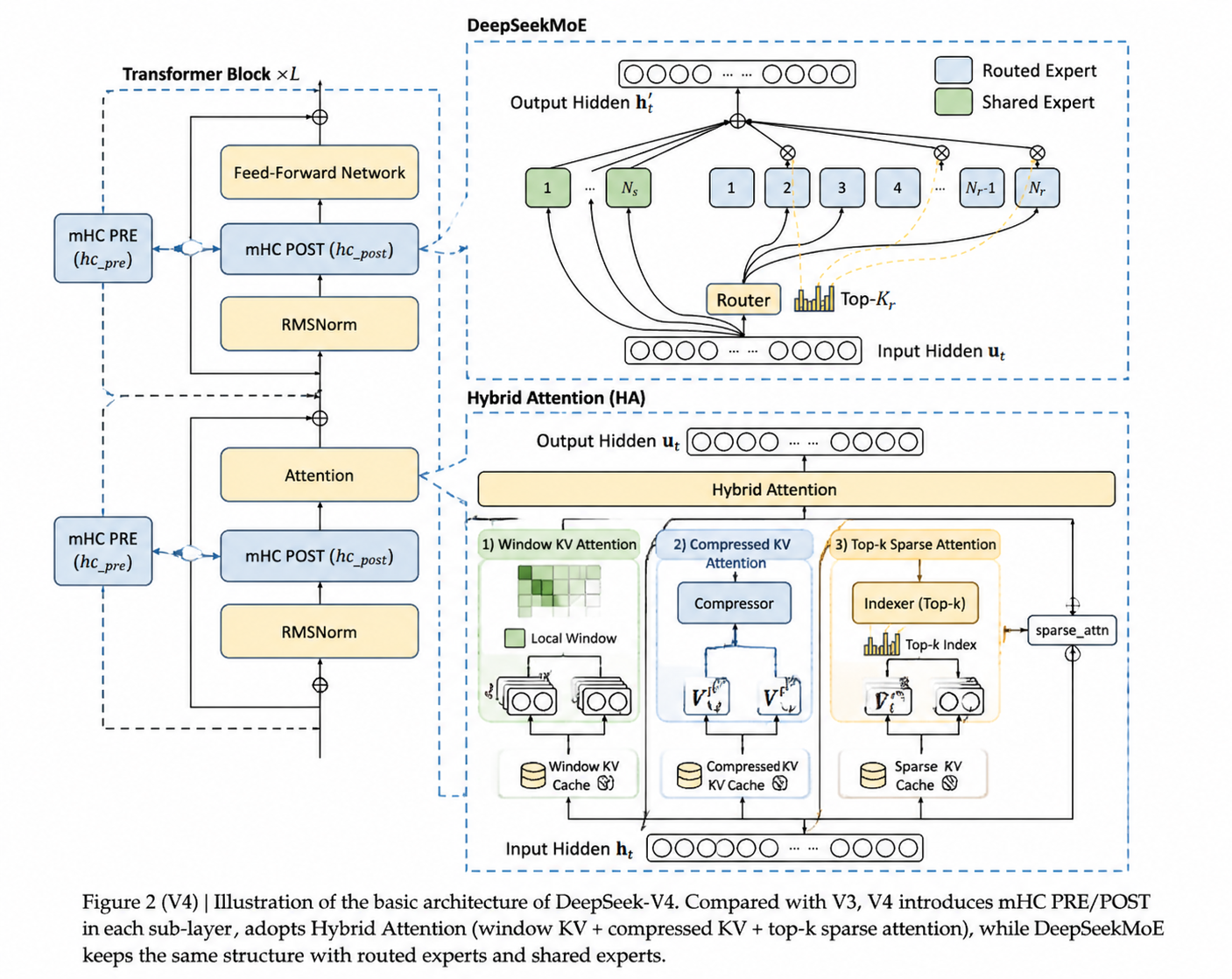
DeepSeek-V4 算法架构
DeepSeek-V4 算法架构(由 Image-2 生成)

DeepSeek-V4 的算法架构整体延续 DeepSeek-V32 的设计,主要在以下几个方面进行了优化:

  • 将 Transformer block 中的残差连接(Residual Connection)替换为 mHC(Manifold-Constrained Hyper-Connections)
  • 将 V3 的 MLA(Multi-Head Latent Attention)替换为混合注意力架构(Hybrid Attention Architecture)
  • 使用 Muon 作为优化器

其他模块(如前馈网络 MoE 与多 Token 预测(MTP))基本与 V3 保持一致。

Transformer Block
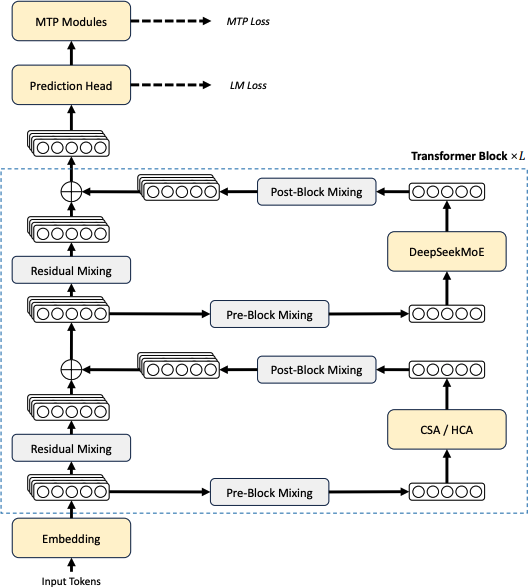
DeepSeek-V4 Transformer Block
DeepSeek-V4 Transformer block 结构

前两项优化点都发生在 Transformer block 内部。如上图所示:DeepSeek-V4 在注意力层混合使用 CSA(Compressed Sparse Attention)与 HCA(Heavily Compressed Attention),在前馈层使用 DeepSeekMoE,并通过 mHC 强化传统残差连接。

mHC(Manifold-Constrained Hyper-Connections)

DeepSeek-V4 系列引入 mHC 用以强化相邻 Transformer block 之间的信号传播。与传统残差连接相比,可以把 mHC 理解为:把“一个残差流”升级成“多条并行残差流”。具体实现时,通过 repeat 将单个残差流扩展为多条并行残差流。

1
h = h.unsqueeze(2).repeat(1, 1, self.hc_mult, 1) # 在进入 Transformer block 之前,先将残差流扩展为多条并行残差流

每一层会动态决定:(1)从哪些流里读出主表示去做子层计算;(2)把子层输出写回到哪些流里;(3)让这些流之间按一个受约束的“混合矩阵”交换信息。以下给出 mHC 和传统残差连接的代码对比:

 1
 2
 3
 4
 5
 6
 7
 8
 9
10
11
12
13
14
15
def forward(self, x: torch.Tensor, start_pos: int, input_ids: Optional[torch.Tensor]) -> torch.Tensor:
    residual = x # [batch_size, seq_len, hc, hidden_size]
+   x, post, comb = self.hc_pre(x, self.hc_attn_fn, self.hc_attn_scale, self.hc_attn_base)
    x = self.attn_norm(x)
    x = self.attn(x, start_pos)
-   x = residual + x   # 传统残差连接,直接通过加法操作实现
+   x = self.hc_post(x, residual, post, comb)

    residual = x
+   x, post, comb = self.hc_pre(x, self.hc_ffn_fn, self.hc_ffn_scale, self.hc_ffn_base)
    x = self.ffn_norm(x)
    x = self.ffn(x, input_ids)
-   x = residual + x
+   x = self.hc_post(x, residual, post, comb)
    return x

mHC 实现里,输入的 x 是一个 [batch_size, seq_len, hc, hidden_size] 的张量,其中 hchc_mult 对应同一超参数,用于控制并行残差流的数量。

函数 hc_pre 决定“这一层该从哪几份副本读信息”,即从多流中计算主表示用于后续子层计算。下面给出一个实现片段:其中 hc_fn 可理解为线性映射的参数,用于将输入映射到 mix_hc 个维度;hc_scale 是 3 维张量,用于控制混合矩阵的约束;hc_basemix_hc 维张量,用于初始化混合矩阵。

hc_split_sinkhorn 是一个函数,用于将混合矩阵拆分成 prepostcomb 三部分,分别对应了“从哪些流里读取信息”、“写哪些流里”和“混合矩阵”。

1
2
3
4
5
6
7
8
9
def hc_pre(self, x: torch.Tensor, hc_fn: torch.Tensor, hc_scale: torch.Tensor, hc_base: torch.Tensor):
    # x: [b,s,hc,d], hc_fn: [mix_hc,hc*d], hc_scale: [3], hc_base: [mix_hc], y: [b,s,hc,d]
    shape, dtype = x.size(), x.dtype
    x = x.flatten(2).float()
    rsqrt = torch.rsqrt(x.square().mean(-1, keepdim=True) + self.norm_eps)
    mixes = F.linear(x, hc_fn) * rsqrt
    pre, post, comb = hc_split_sinkhorn(mixes, hc_scale, hc_base, self.hc_mult, self.hc_sinkhorn_iters, self.hc_eps)
    y = torch.sum(pre.unsqueeze(-1) * x.view(shape), dim=2)
    return y.to(dtype), post, comb

hc_post 决定“子层的新信息写到哪些副本里,以及旧副本之间怎么混合”,即将子层的新信息写回到多流中,同时根据混合矩阵计算出新的主表示。这里用到 postcomb 两个张量,就是 hc_pre 中计算得到的分流矩阵和混合矩阵。

1
2
3
4
def hc_post(self, x: torch.Tensor, residual: torch.Tensor, post: torch.Tensor, comb: torch.Tensor):
    # x: [b,s,d], residual: [b,s,hc,d], post: [b,s,hc], comb: [b,s,hc,hc], y: [b,s,hc,d]
    y = post.unsqueeze(-1) * x.unsqueeze(-2) + torch.sum(comb.unsqueeze(-1) * residual.unsqueeze(-2), dim=2)
    return y.type_as(x)

混合矩阵的约束:在 mHC 中,每个 token / 层都会生成一个流间混合矩阵(代码里的 comb),用于在多条“残差流”之间搬运与重组旧状态。如果不加约束,混合矩阵可能出现尺度放大、信息坍缩到少数通道等问题,导致训练与深层信息传播不稳定。Sinkhorn 迭代通过交替进行行/列归一化,把混合矩阵投影到近似“双随机矩阵”(非负、行和列都约为 1)的集合附近,从而实现“质量守恒”的稳定混合:信息在通道间可交换,但不易无界放大或被单通道吸走。

hc_sinkhorn_iters 控制该投影的迭代次数,次数越多约束越严格但计算开销更大。

mHC 通过多流、可路由且受约束的残差机制,提升了表示的可分解性与信息传递灵活性,同时改善深层训练与长程依赖建模的稳定性。

混合注意力(Hybrid Attention)

尽管目前出现了各种注意力机制(Linear Attention、Sparse Attention、Heavily Compressed Attention 等),它们的核心目标大多是在尽量不损失效果的前提下提升计算效率。从实现形式上看,这些机制仍遵循自注意力的通用框架。下面给出一个简化的伪代码:

1
2
3
4
5
6
7
8
def attention(self, x):
    q = x_to_q(x) 
    k = x_to_k(x) 
    v = x_to_v(x) 
    q, k, v = insert_position_embedding(q, k, v) # 注入位置编码
    o = apply_attention_mix(q, k, v) # 注意力计算,矩阵计算
    new_x = o_to_x(o) 
    return new_x

Q, K, V 映射与位置编码注入

首先介绍 x_to_qx_to_kx_to_v 这三个函数,它们将输入的 x 分别转换为查询、键值张量。insert_position_embedding 函数用于将位置编码注入到查询、键值张量中。 以下是 DeepSeek-V4 中的实现:

 1
 2
 3
 4
 5
 6
 7
 8
 9
10
11
12
13
14
15
16
# module
self.wq_a = Linear(self.dim, self.q_lora_rank)
self.wq_b = ColumnParallelLinear(self.q_lora_rank, self.n_heads * self.head_dim)
self.wkv = Linear(self.dim, self.head_dim)
self.q_norm = RMSNorm(self.q_lora_rank, self.eps)
self.kv_norm = RMSNorm(self.head_dim, self.eps)

# forward
qr = q = self.q_norm(self.wq_a(x))
q = self.wq_b(q).unflatten(-1, (self.n_local_heads, self.head_dim))
q *= torch.rsqrt(q.square().mean(-1, keepdim=True) + self.eps)
apply_rotary_emb(q[..., -rd:], freqs_cis)
kv = self.wkv(x)
kv = self.kv_norm(kv)
apply_rotary_emb(kv[..., -rd:], freqs_cis)
act_quant(kv[..., :-rd], 64, scale_fmt, scale_dtype, True)

使用线性层映射将输入映射到对应的维度空间,并使用相对位置编码注入位置信息;可以注意到多头的设置主要在 q 上。其中 act_quant 的作用是量化,把 KV 向量里“非 RoPE 的维度”做 QAT 对齐量化为 FP8 精度,而 RoPE 相关维度保持原精度,以兼顾“与训练时量化分布一致”和“位置编码精度”。

Sparse Attention

在完成 \(q\)、\(k\)、\(v\) 以及位置编码注入后,Hybrid Attention 的关键不在于对所有历史 token 计算完整的注意力矩阵,而是先为每个 query token 构造一个候选 KV 索引集合 topk_idxs,然后只在这些候选位置上做注意力计算(Sparse Attention)。这样复杂度从 \(O(L^2)\) 下降到近似 \(O(L \cdot K)\),其中 \(K\) 是每个 query 对应的候选集合大小。

在 DeepSeek-V4 中,候选集合由两部分组成:

  • Window tokens(局部高保真):滑动窗口内的最近历史 token,保证局部依赖的精细建模。
  • Compressed tokens(全局低成本):对远程历史做压缩后得到的 KV 记忆,用少量 token 覆盖长上下文。
 1
 2
 3
 4
 5
 6
 7
 8
 9
10
11
topk_idxs = get_window_topk_idxs(win, bsz, seqlen, start_pos)

if self.compress_ratio:
    offset = kv.size(1) if start_pos == 0 else win
    if self.indexer is not None:
        compress_topk_idxs = self.indexer(x, qr, start_pos, offset)
    else:
        compress_topk_idxs = get_compress_topk_idxs(ratio, bsz, seqlen, start_pos, offset)
    topk_idxs = torch.cat([topk_idxs, compress_topk_idxs], dim=-1)

topk_idxs = topk_idxs.int()

其中:

  • win = window_size:窗口大小(如 128)。
  • ratio = compress_ratio:压缩比,ratio>0 表示该层启用压缩记忆。
  • offset:将窗口索引与压缩索引映射到统一的 KV 缓存坐标系(prefill 与 decode 阶段略有不同)。关于 KV cache 的背景可参考 Qwen3-Omni 博客的附加内容。

CSA 与 HCA:两种压缩策略的对应关系

在开源模型 DeepSeek-V4-Pro 中,模型一共有 61 层,对于每一层注意力机制的压缩率列表如下:

1
compress_ratios = [128, 128, 4, 128, 4, 128, 4, 128, 4, 128, 4, 128, 4, 128, 4, 128, 4, 128, 4, 128, 4, 128, 4, 128, 4, 128, 4, 128, 4, 128, 4, 128, 4, 128, 4, 128, 4, 128, 4, 128, 4, 128, 4, 128, 4, 128, 4, 128, 4, 128, 4, 128, 4, 128, 4, 128, 4, 128, 4, 128, 4, 0]

除了最后一层,其余层都对历史窗口做了不同程度的压缩,压缩比的选择分别是 $4$ 和 $128$ 两种,分别对应 CSA(Compressed Self Attention, compress_ratio=4)和 HCA(Heavy Compressed Attention, compress_ratio=128)两种压缩注意力机制。

两种压缩注意力机制在筛选候选 KV 索引时,分别采用不同的策略。CSA 更强调“相关性选择”,HCA 更强调“极致压缩”。

  • CSA(Compressed Sparse Attention):轻度压缩 + 稀疏检索。该模式下会启用 Indexer:对压缩 KV 做学习型相关性打分,并为每个 query 选择 top-k 压缩位置,从而实现“压缩 + 稀疏检索”的长程注意力。
CSA 选择器层 代码实现 (可跳过,本篇暂不展开讨论实现细节)
  1
  2
  3
  4
  5
  6
  7
  8
  9
 10
 11
 12
 13
 14
 15
 16
 17
 18
 19
 20
 21
 22
 23
 24
 25
 26
 27
 28
 29
 30
 31
 32
 33
 34
 35
 36
 37
 38
 39
 40
 41
 42
 43
 44
 45
 46
 47
 48
 49
 50
 51
 52
 53
 54
 55
 56
 57
 58
 59
 60
 61
 62
 63
 64
 65
 66
 67
 68
 69
 70
 71
 72
 73
 74
 75
 76
 77
 78
 79
 80
 81
 82
 83
 84
 85
 86
 87
 88
 89
 90
 91
 92
 93
 94
 95
 96
 97
 98
 99
100
101
102
103
104
105
106
107
108
109
110
111
112
113
114
115
116
117
118
119
120
121
122
123
124
125
126
127
128
129
130
131
132
133
134
135
136
137
138
139
140
141
142
143
144
145
146
147
148
149
150
151
152
153
154
155
class Compressor(nn.Module):
    """Compresses KV cache via learned gated pooling over `compress_ratio` consecutive tokens.
    When overlap=True (ratio==4), uses overlapping windows for smoother compression boundaries."""

    def __init__(self, args: ModelArgs, compress_ratio: int = 4, head_dim: int = 512, rotate: bool = False):
        super().__init__()
        self.dim = args.dim
        self.head_dim = head_dim
        self.rope_head_dim = args.rope_head_dim
        self.nope_head_dim = head_dim - args.rope_head_dim
        self.compress_ratio = compress_ratio
        self.overlap = compress_ratio == 4
        self.rotate = rotate
        coff = 1 + self.overlap

        self.ape = nn.Parameter(torch.empty(compress_ratio, coff * self.head_dim, dtype=torch.float32))
        # wkv and wgate in the checkpoint is stored in bf16, while the parameter here is stored in fp32 for convenient.
        # When overlap, the first half of dims is for overlapping compression, second half for normal.
        self.wkv = Linear(self.dim, coff * self.head_dim, dtype=torch.float32)
        self.wgate = Linear(self.dim, coff * self.head_dim, dtype=torch.float32)
        self.norm = RMSNorm(self.head_dim, args.norm_eps)
        self.kv_cache: torch.Tensor = None  # assigned lazily from Attention.kv_cache
        # State buffers for decode-phase incremental compression.
        # With overlap: state[:, :ratio] = overlapping window, state[:, ratio:] = current window.
        self.register_buffer("kv_state", torch.zeros(args.max_batch_size, coff * compress_ratio, coff * self.head_dim, dtype=torch.float32), persistent=False)
        self.register_buffer("score_state", torch.full((args.max_batch_size, coff * compress_ratio, coff * self.head_dim), float("-inf"), dtype=torch.float32), persistent=False)
        self.freqs_cis: torch.Tensor = None

    def overlap_transform(self, tensor: torch.Tensor, value=0):
        # tensor: [b,s,r,2d]
        b, s, _, _ = tensor.size()
        ratio, d = self.compress_ratio, self.head_dim
        new_tensor = tensor.new_full((b, s, 2 * ratio, d), value)
        new_tensor[:, :, ratio:] = tensor[:, :, :, d:]
        new_tensor[:, 1:, :ratio] = tensor[:, :-1, :, :d]
        return new_tensor

    def forward(self, x: torch.Tensor, start_pos: int):
        assert self.kv_cache is not None
        bsz, seqlen, _ = x.size()
        ratio, overlap, d, rd = self.compress_ratio, self.overlap, self.head_dim, self.rope_head_dim
        dtype = x.dtype
        # compression need fp32
        x = x.float()
        kv = self.wkv(x)
        score = self.wgate(x)
        if start_pos == 0:
            should_compress = seqlen >= ratio
            remainder = seqlen % ratio
            cutoff = seqlen - remainder
            offset = ratio if overlap else 0
            if overlap and cutoff >= ratio:
                self.kv_state[:bsz, :ratio] = kv[:, cutoff-ratio : cutoff]
                self.score_state[:bsz, :ratio] = score[:, cutoff-ratio : cutoff] + self.ape
            if remainder > 0:
                kv, self.kv_state[:bsz, offset : offset+remainder] = kv.split([cutoff, remainder], dim=1)
                self.score_state[:bsz, offset : offset+remainder] = score[:, cutoff:] + self.ape[:remainder]
                score = score[:, :cutoff]
            kv = kv.unflatten(1, (-1, ratio))
            score = score.unflatten(1, (-1, ratio)) + self.ape
            if overlap:
                kv = self.overlap_transform(kv, 0)
                score = self.overlap_transform(score, float("-inf"))
            kv = (kv * score.softmax(dim=2)).sum(dim=2)
        else:
            should_compress = (start_pos + 1) % self.compress_ratio == 0
            score += self.ape[start_pos % ratio]
            if overlap:
                self.kv_state[:bsz, ratio + start_pos % ratio] = kv.squeeze(1)
                self.score_state[:bsz, ratio + start_pos % ratio] = score.squeeze(1)
                if should_compress:
                    kv_state = torch.cat([self.kv_state[:bsz, :ratio, :d], self.kv_state[:bsz, ratio:, d:]], dim=1)
                    score_state = torch.cat([self.score_state[:bsz, :ratio, :d], self.score_state[:bsz, ratio:, d:]], dim=1)
                    kv = (kv_state * score_state.softmax(dim=1)).sum(dim=1, keepdim=True)
                    self.kv_state[:bsz, :ratio] = self.kv_state[:bsz, ratio:]
                    self.score_state[:bsz, :ratio] = self.score_state[:bsz, ratio:]
            else:
                self.kv_state[:bsz, start_pos % ratio] = kv.squeeze(1)
                self.score_state[:bsz, start_pos % ratio] = score.squeeze(1)
                if should_compress:
                    kv = (self.kv_state[:bsz] * self.score_state[:bsz].softmax(dim=1)).sum(dim=1, keepdim=True)
        if not should_compress:
            return
        kv = self.norm(kv.to(dtype))
        if start_pos == 0:
            freqs_cis = self.freqs_cis[:cutoff:ratio]
        else:
            freqs_cis = self.freqs_cis[start_pos + 1 - self.compress_ratio].unsqueeze(0)
        apply_rotary_emb(kv[..., -rd:], freqs_cis)
        if self.rotate:
            kv = rotate_activation(kv)
            fp4_act_quant(kv, fp4_block_size, True)
        else:
            act_quant(kv[..., :-rd], 64, scale_fmt, scale_dtype, True)
        if start_pos == 0:
            self.kv_cache[:bsz, :seqlen // ratio] = kv
        else:
            self.kv_cache[:bsz, start_pos // ratio] = kv.squeeze(1)
        return kv


class Indexer(torch.nn.Module):
    """Selects top-k compressed KV positions for sparse attention via learned scoring.
    Has its own Compressor (with Hadamard rotation) to build compressed KV for scoring."""

    def __init__(self, args: ModelArgs, compress_ratio: int = 4):
        super().__init__()
        self.dim = args.dim
        self.n_heads = args.index_n_heads
        self.n_local_heads = args.index_n_heads // world_size
        self.head_dim = args.index_head_dim
        self.rope_head_dim = args.rope_head_dim
        self.index_topk = args.index_topk
        self.q_lora_rank = args.q_lora_rank
        self.wq_b = ColumnParallelLinear(self.q_lora_rank, self.n_heads * self.head_dim)
        self.weights_proj = ColumnParallelLinear(self.dim, self.n_heads, dtype=torch.bfloat16)
        self.softmax_scale = self.head_dim ** -0.5
        self.compress_ratio = compress_ratio

        self.compressor = Compressor(args, compress_ratio, self.head_dim, True)
        self.register_buffer("kv_cache", torch.zeros(args.max_batch_size, args.max_seq_len // compress_ratio, self.head_dim), persistent=False)
        self.freqs_cis = None

    def forward(self, x: torch.Tensor, qr: torch.Tensor, start_pos: int, offset: int):
        bsz, seqlen, _ = x.size()
        freqs_cis = self.freqs_cis[start_pos:start_pos+seqlen]
        ratio = self.compress_ratio
        rd = self.rope_head_dim
        end_pos = start_pos + seqlen
        if self.compressor.kv_cache is None:
            self.compressor.kv_cache = self.kv_cache
            self.compressor.freqs_cis = self.freqs_cis
        q = self.wq_b(qr)
        q = q.unflatten(-1, (self.n_local_heads, self.head_dim))
        apply_rotary_emb(q[..., -rd:], freqs_cis)
        q = rotate_activation(q)
        # use fp4 simulation for q and kv in indexer
        fp4_act_quant(q, fp4_block_size, True)
        self.compressor(x, start_pos)
        weights = self.weights_proj(x) * (self.softmax_scale * self.n_heads ** -0.5)
        # We performed QAT here, kv could also use fp8 format, though current implementation uses bf16
        index_score = torch.einsum("bshd,btd->bsht", q, self.kv_cache[:bsz, :end_pos // ratio])
        index_score = (index_score.relu_() * weights.unsqueeze(-1)).sum(dim=2)
        if world_size > 1:
            dist.all_reduce(index_score)
        if start_pos == 0:
            mask = torch.arange(seqlen // ratio).repeat(seqlen, 1) >= torch.arange(1, seqlen + 1).unsqueeze(1) // ratio
            index_score += torch.where(mask, float("-inf"), 0)
        topk_idxs = index_score.topk(min(self.index_topk, end_pos // ratio), dim=-1)[1]
        if start_pos == 0:
            mask = topk_idxs >= torch.arange(1, seqlen + 1).unsqueeze(1) // ratio
            topk_idxs = torch.where(mask, -1, topk_idxs + offset)
        else:
            topk_idxs += offset
        return topk_idxs
  • HCA(Heavily Compressed Attention):重度压缩。此时压缩 token 数量极少,更偏向全局摘要记忆;实现上一般不启用学习检索,而是使用规则映射生成压缩候选索引,以获得极低成本的长上下文覆盖。
HCA 选择函数 代码实现
1
2
3
4
5
6
7
8
def get_compress_topk_idxs(ratio: int, bsz: int, seqlen: int, start_pos: int, offset: int):
    if start_pos > 0:
        matrix = torch.arange(0, (start_pos + 1) // ratio) + offset
    else:
        matrix = torch.arange(seqlen // ratio).repeat(seqlen, 1)
        mask = matrix >= torch.arange(1, seqlen + 1).unsqueeze(1) // ratio
        matrix = torch.where(mask, -1, matrix + offset)
    return matrix.unsqueeze(0).expand(bsz, -1, -1)

在获取到候选索引 topk_idxs 后,模型调用 sparse_attn(q, kv_cache, ...) 仅对候选位置执行注意力计算。模型只需关注候选集合中的有效 token,而无需处理所有历史 token,从而实现高效计算。

输出投影

注意力输出 o 会先对 RoPE 维做逆变换(inverse),再通过分组的低秩输出投影映射回原始维度空间,得到该注意力层的最终输出:

查看代码:输出投影
1
2
3
4
5
apply_rotary_emb(o[..., -rd:], freqs_cis, inverse=True)
o = o.view(bsz, seqlen, self.n_local_groups, -1)
wo_a = self.wo_a.weight.view(self.n_local_groups, self.o_lora_rank, -1)
o = torch.einsum("bsgd,grd->bsgr", o, wo_a)
new_x = self.wo_b(o.flatten(2))

至此,Hybrid Attention 在保持窗口注意力高保真建模能力的同时,引入压缩记忆与稀疏计算,实现长上下文场景下的高效注意力计算。

Muon

本节不展开 Muon 的细节,可参考 Moonshot Muon

DeepSeek-V4 优化器配置细节

DeepSeek-V4 对优化器采用精细化分工:

优化器覆盖参数
AdamW(Loshchilov & Hutter, 2017)嵌入层、预测头、mHC 静态偏置与门控、全部 RMSNorm 权重
Muon除上述外的所有可训练参数

Muon 实现沿用 Moonshot 版三项核心技巧:

  • 对 Muon 参数施加 权重衰减
  • 引入 Nesterov 动量 提升收敛稳定性
  • 对更新矩阵做 RMS 重缩放,直接复用 AdamW 超参数,无需二次调参

与原版差异:

  • 正交化步骤改用 混合 Newton-Schulz 迭代,兼顾数值精度与低延迟
  • 移除 QK-Clip 技巧

如有错误或遗漏,欢迎指正!


  1. DeepSeek-AI, DeepSeek-V4: Towards Highly Efficient Million-Token Context Intelligence. https://huggingface.co/collections/deepseek-ai/deepseek-v4 ↩︎

  2. DeepSeek-AI, DeepSeek-V3 Technical Report. https://github.com/deepseek-ai/DeepSeek-V3 ↩︎

使用 Hugo 构建
主题 StackJimmy 设计